
“When the facts are incontrovertible and the conclusions inescapable; when success could bring a vast improvement in the welfare and happiness of millions; and when the penalty of failure is global disaster: surely humanity will want to collaborate and make sure that sanity prevails. ...maybe it is time that instead of controlling the environment for the benefit of the population, we should control the population to ensure the survival of the environment.” Sir David Attenborough Letter to Professor Guillebaud
Q: What will the world be like when our population starts getting smaller?
Everyone and every living thing on this planet will benefit from an improved human population density. The promise of abundant living will once again be more than wishful thinking.
Shortages of resources are caused by longages of consumers, so the fewer we number, the greater our material wealth could be. Social justice demands a more equal opportunity to exploit Earth’s resources. A dubious goal, more easily achieved when there are fewer people to redistribute resources to.
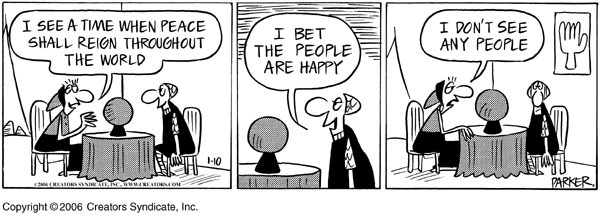
Conflicts arise primarily out of resource shortages, so peace becomes more likely with fewer people occupying the same lands and drawing from the same wells.
Children will be more respected and better cared for as there are fewer of them. The appalling numbers of children dying today could be reduced to an ugly page in the history books.
Housing will become plentiful without building more houses. A sustainable civilization will be possible when we stop taking more than is being regenerated by Nature.
Naturally, Nature stands to gain even more in the long run by a phase-out of the human species. As fewer people inhabit an area, less damage is done to wildlife’s habitat. Restoration will be possible when cities shrink and green spaces are expanded. Eventually, extinctions will become less common as habitat is restored and preserved for wildlife.
The sooner we stop increasing the demands we make on Earth’s biosphere, the greater the diversity of species of plants and animals we will leave, and the healthier Gaia will be.
All of us can join in the fun of imagining for ourselves what our world will be like when our numbers are shrinking instead of growing. What would it be like to be among the last people on Earth?
A few of us alive today might see the day our density peaks, but, barring a tragic dieoff, none of us will be around to see fewer than seven billion again. We can only dream.
Flint, Michigan and Youngstown, Ohio accomodate a shrinking human population, unfortunately caused by collapse of employment base rather than natural attrition. Flint update 2011.Sounds like paradise, doesn’t it? Gaia completely cured of pox humanus. Without us meddlesome humans, all other species would get their fair chance at survival.
Naturally, it’s not that simple, but just for fun, let’s envision an impossible dream: all human sperm suddenly and permanently loses viability—no impregnated human egg begins meiosis to form a zygote—none transforms from embryo into the sacred fetus, is carried to term and sentenced to life. Zero conceptions, wanted nor un.
A wonderful fantasy. Phones in crisis pregnancy centers would fall mysteriously silent. Sperm banks would go bankrupt after fraudulently milking the infertile. Adoption agencies would fruitlessly increase baby bounties, and charge an arm and a leg for whoever’s in stock, damaged or not. Needless panic would be hilarious. Like people frantically searching for their oars after the boat has beached.
Benefits would begin immediately for both biosphere and humanity. Resources wasted on redundant breeding could be redirected to existing members of the human family in need. Loving care and nurturing now expended raising superfluous heirs could be given over to stopping the killing and beginning the healing. A sweet dream.
However, an alternative birthless future is also possible. One where people see no need to preserve Earth’s biosphere since none of our kind will be around to enjoy cartoons of it. Nature’s destruction could just as easily continue unabated as we pass into extinction. It doesn’t take billions of humans to destroy massive ecosystems, as shown by the exploits of empires from ancient times through the present.
No, human extinction alone won’t stop destruction of Earth’s
biosphere. Our collective consciousness must evolve from anthrocentric to
ecocentric: to where Earth has first priority. Then, finally, our efforts
will shift from desperate, often futile, damage control to a hopeful
restoration of natural balance in Earth’s ecosystems.
Homo sapiens is a newcomer to the web of life on Earth. Life progressed for thousands of millions of years before anything resembling our kind came along.
However, life on Earth will never be the same, even if we were to disappear tomorrow. The rate of extinctions today rivals that of the days of the dinosaurs’ demise. The sooner we go extinct, the greater the biological diversity we’ll leave behind to carry on.
On our present course, preserving most larger mammals is not likely, especially the carnivores. With growing awareness, we might be able to turn things around in time to stop extinctions at the level of small mammals, reptiles, and fish.
We might fail to avoid the massive dieoff which typically follows population booms such as the one we are part of today. If this happens before the biosphere collapses, our involuntary extinction could be avoided... this time. The few remaining Homo sapiens would start over in a severely degraded environment, just as we have done regionally countless times over the past 10,000 years.
Alternately, our activities could bring about a collapse of Earth’s biosphere before industrial civilization’s collapse. There’s speculation we have passed the tipping point toward this collapse, and naturally our dieoff to involuntary extinction would soon follow.
After this worst-case scenario, life forms as complex as insects might still exist, and in 10 to 50 million years, new species will have evolved, as they have after each of Earth’s five previous extinction events. Homo sapiens and our artifacts would join the fossil record: a thin lens of squandered potential.
On the bright side, our voluntary phase out, begun soon enough, would avoid the tragic collapse of both our global civilization and the biosphere. Humanity could improve conditions for all life while enjoying renewed bounty from restored ecosystems. Abundant resources would make world peace possible, and our shrinking human family could grow closer together.
Sites showing human-free areas and a human-free EarthOur extinction is not just possible, it’s inevitable: billions of species have come and gone already.
But, will enough of us reach the level of awareness needed to voluntarily reverse our present course toward involuntary extinction? This isn’t likely, which is all the more reason not to create another of ourselves.
Although the odds are against us, we can at least accept the advice attributed to Gandhi, and be the change we want to see in the world.
We’re the only species evolved enough to consciously go extinct for the good of all life, or which needs to. Success would be humanity’s crowning achievement.
May we live long and die out.

