NYT October 30, 1993
Q: What good is a healthy biosphere if there are no humans around to enjoy it?
The same good it was before we furless beach apes came along.
A human-centered world view only values other species by what they can do for us, or for “our children’s children.” We’re collectively so centered on our own species that nothing matters except in relation to ourselves.
It’s like our ancient view of the universe with Earth at the center: it took a long time for people to accept that our planet is just one of many orbiting a star, which is also just one of many in a galaxy, which is also just one of many in the universe.
An Earth-centered world view sees Homo sapiens as one of tens of millions of species in Earth’s biosphere. We are exceptional in many ways, and so are the other life forms we share this rare and wonderful place with.
By envisioning Earth’s entire biosphere, acknowledging the intrinsic value of every life form, our voluntary extinction begins to make sense.
“More than any other time in history, mankind faces a crossroads. One path leads to despair and utter hopelessness. The other, to total extinction. Let us pray we have the wisdom to choose correctly”~Woody Allen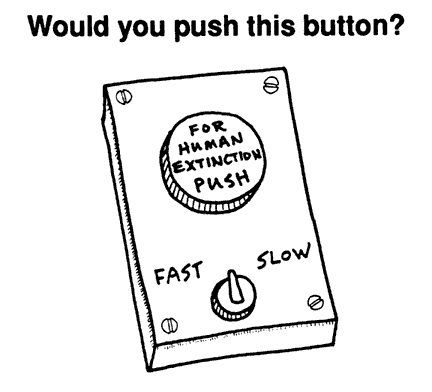
I can justify the existence of the human race in spite of all the obvious evidence.
I’m vehement about preserving life and returning Earth to a natural paradise.
For amusement only.
There is no button, there never will be a button, and even if there were, pushing it would go against the voluntary ethic of VHEMT. This is simply a philosophical exercise to help clarify values.
Q: Isn’t over population just a symptom of the problem rather than the cause?
Some say, “Overpopulation is more a symptom than a cause of our fundamental problems.”
So, this means that Earth has too many people on it because of our problems rather than Earth having problems because there are too many people on it.
It’s like:
“Gee, Dear, there’s sure a lot of noise and pollution in the air.”
“Yeah, I wish we could breathe.”
“Huh? Oh, we can still breed. C’mon, coff, coff, let’s make more of us.”Or maybe you can imagine:
“I’m outta work, homeless, and got a bad disease... makes me feel like creating an heir to share all this with.”Our biggest problem, destruction of Earth’s biosphere, is undoubtedly a symptom rather than a cause of excessive human breeding.
But to be fair, it’s true that some of our problems promote higher birth rates—especially mental problems like mindless conformity and massive denial.
In addition, problems like high mortality rates, a lack of care for the elderly, low status for women and their subsequent loss of reproductive freedom, all significantly contribute to high birth rates. In return, an excess of humans makes each of those problems worse. In some ways, over-population is both a symptom and a cause: a self-perpetuating, malicious cycle.
In contrast, voluntary human extinction is a positively motivated, beneficial cycle of solutions and benefits for all. Besides being a “symptom” of a heightened awareness, The Movement is “causing” a higher awareness.
Whether our problems are symptoms or causes, they’ll be more easily solved when there are fewer of us.
Q: Would we be better off if we had never been born?
The philosophy of antinatalism is one major route to voluntary human extinction. The idea is that we have no right to bring someone into existence where they will surely suffer. They’re not suffering in non-existence.
I wish I'd never been born: the rise of the anti-natalists
Although the term is specific to this philosophy, it is increasingly applied to any negative assignment to human birth.
Wikipdeia entry includes historical antinatalist philosophy.
“Adherents view life not as a gift and a miracle, but a harm and an imposition. And their notion that having children may be a bad idea seems to be gaining mainstream popularity.”Better Never to Have Been: The Harm of Coming into Existence 2006 by David Benatar, University of Cape Town professor, expresses antinatalist philosophy based on inevitable harm which befalls each of us. “Anti-natalism also implies that it would be better if humanity became extinct. Although counter-intuitive for many, that implication is defended, not least by showing that it solves many conundrums of moral theory about population.” Editorial review.
Amanda Sukenick interviews David Benatar on Exploring Antinatalism podcast. Listen
Gut ist der Schlaf,
der Tod ist besser - freilich
Das beste wäre, nie geboren sein.
Sleep is good.
Death is better,
but the best is to have never been born.Heinrich Heine 1797-1856
Morphine 1835-1836
See also, quote from Arthur Schopenhauer Sufferings of the World 1851
Article in the UK Vegan Society’s newsletter. “It must be said that if you, as a vegan, choose to give birth to a child and it later turns out to be a meat eater, it renders your own personal commitment completely invalid.”
Q: Are religions to blame for human overpopulation?
All major religions include warnings against irresponsible breeding. Churches, perhaps in hopes of increasing their flock sizes, ignore those passages and emphasize natalist aspects of their dogma.
The Bible says be fruitful.
God is often quoted as telling us to “be fruitful and multiply, and replenish the Earth and subdue it: and have dominion over the fish of the sea and over the fowl of the air, and over every living thing that moveth upon the earth.” Genesis 1:28 KJV.
When we are told to “replenish the Earth,” the first people had only just been created, so “replenish” probably refers to other life forms. God is instructing us to reforest, re-establish wildlife habitat, enable wildlife to flourish, and replenish Earth with His blessed creatures.
Having “dominion” includes the responsibility to preserve and care for “every living thing which moveth on the Earth.” Bringing about a creature’s extinction most certainly violates this divine directive.
Humans are not the only creatures blessed by God. In Genesis 1:22, God blesses the other lives He has created and instructs them also to “be fruitful and multiply.”
We can’t assume that instructions given before our fall from grace and banishment from the Garden of Eden apply afterward. In Genesis 3:16, God told Eve, “I will greatly multiply thy sorrow and thy conception; in sorrow thou shalt bring forth children . . .”
For Christians, this curse has been lifted by Jesus’ sacrifice on the cross, and no longer applies. Now, where contraception is available, we needn’t bring forth children in sorrow.
There are limits to our fruitful multiplying:
“Woe unto them that join house to house, that lay field to field, ‘til there be no place, that they may be placed alone in the midst of the Earth!” Isaiah 5:8 KJV
We seem to be exceeding God’s admonishment.
God also advises us to care for the children who already exist instead of giving birth to more:
“Sing, O barren, thou that didst not bear; break forth in singing, and cry aloud, thou that didst not travail with child: for more are the children of the desolate than the children of the married wife, saith the Lord.” Isaiah 54:1 KJV
If the second coming of Jesus is to be soon, then this is not the time to bring another person into the world. Jesus speaks of these last days:
“For behold, the days are coming, in which they will say, ‘Blessed are the barren, and the wombs that never bore, and the breasts which never gave suck.’” Luke 23:29 RSV
As this website proves, those days Jesus foretold of have come to pass. It is cruel to bring forth children who “will say to the mountains, ‘Fall on us’; and to the hills, ‘Cover us.’” Luke 23:30.The apostle Paul compares our earthly existence to that of a house:
“...if our earthly house of this tabernacle were dissolved, we have a building of God... whilst we are at home in the body, we are absent from the Lord.” II Corinthians 5:1-6 KJV.
Thus, extinction of the human race on Earth doesn’t mean an end to humanity. Extinction is in accordance with God’s plan for us.
Jesus Christ lived His life as a lesson to us all, and begat naught. Let us follow His example and concentrate on the spiritual journey to God, rather than on human endeavors such as producing more humans.
We have been fruitful and multiplied, now it is time to mature and nurture.
My religion forbids contraceptives.
Pope Paul VI didn’t draw directly from scriptures in 1968 when he issued Humanae Vitae. Loosely translated from Latin, it means, “It’s a no-no to put pee-pee in muff-muff, except to make bee-bee.”
This encyclical made the use of contraception cause for excommunication, eternal damnation, and so on, but it’s just another Papal Bull, an edict from a Diet of Worms, or Mufti’s fatwa type thing. The Bible doesn’t outlaw contraception or abortion, the Pope does, and Papal infallibility means never saying you were wrong—nor that any Pope was ever wrong.
We are wholely in need of a See change
Note: Above graphic digitally restored from an original poster, with “1968 Cabinet type shop” as the only identifying label. It is presented here as a historical documentation of the times, and is not intended to be disrespectful of Pope Paul VI’s Italian accent. When Earl Butz, Secretary of Agriculture in President Nixon’s cabinet at the time, commented, “You no playa da game, you no makea da rules,” it’s possible he intended to be disrespectful of Pope Paul VI’s accent.
Parody of Roman Catholic position on human reproduction
How many children we have is up to God, not us.“Therefore thus saith the Lord God; ‘Because ye multiplied more than the nations that are round about you... Behold, I, even I, am against thee, and will execute judgements in the midst of thee in the sight of the nations’.” Ezekiel 5:7-8 KJV
Thus, we have free will to breed or not to breed, and are to be responsible, not to simply rely on divine contraception. One emphasized judgement to be executed in cases of excessive breeding is famine, leading to cannibalism. Verily, this judgement has been visited upon numerous peoples who failed to heed the word of the Lord their God.Anglican Church recommends less breeding
“Out of care for the whole of creation, particularly the poorest of humanity and the life forms who cannot speak for themselves … it is not responsible to stand by and remain silent. Unless we take account of the needs of future life on Earth, there is a case that we break the eighth commandment, ‘Thou shall not steal’.”
A Taoist view
From The Chronicles of Tao: “The two Taoists reminded Fi-Hung that the critical thing in life was to die a spiritual death, to merge with the void. In order to do so, one had to be free of the cycle of reincarnation. This meant absolutely no Earthly ties.
“The important point was that having children automatically tied one to the cycle of reincarnation. How could it be otherwise? By passing on one’s metaphysical and physical genetics, one perpetuated one’s Earthly karma.
“This was why the sages had no biological children.”
A Buddhist view
11th Link: BIRTH (jati)
This link is represented by the very explicit image of a woman giving birth to a child.Birth means the appearance of the five aggregates (material form, feeling, perception, formation and consciousness)in the mother’s womb.
Birth, as one might expect, is shown as a mother in the process of childbirth, a painful business and a reminder of how dukkha cannot be avoided in any life. Whatever the future life is to be, if we are not able to bring the wheel to a stop in this life, certainly that future will arise conditioned by the kamma made in this life. But it is no use thinking that since there are going to be future births, one may as well put off Dhamma practice until then,for it is not sure what those future births will be like. And when they come around, they are just the present moment as well. So no use waiting!
Venerable Nagarjuna shows that it is better to extricate oneself:
“Where birth takes place,
quite naturally are fear,
old age and misery,
disease, desire and death,
“As well a mass of other ills.
When birth’s no longer brought about.
All the links are ever stopped.”
L.K. 111
Q: If the human race is phased out, how will we reincarnate here?
Our situation is so precarious that we can’t assume that there will be an earthly biosphere to reincarnate in for our next life. It’s time to make rapid advancement in this life, rather than slacking off because we think we’ll have another chance at the wheel of life.
A Pagan/Wiccan view
Excerpt:
“I, as a Wiccan and as a human being, have a responsibility to this planet. This includes putting aside any desires I might have that are dangerous to the Earth who nourishes me. As fun as it might be to drive around in a car instead of walking, or eat meat, or leave the lights in my house on all night, I don’t do these things, because of the toll they take. And I would expect that most other Wiccans would feel the same—some marginal sacrifice is necessary by all of us, or things will get bad, quick.“But one area that most Pagans I know simply ignore in their personal quests for environmental amelioration is that of overpopulation, a phenomenon which does exist, despite what the Pollyanna types will tell you. Or, they lament about it but do nothing themselves.
“What can be done? Well, it’s obvious.
“Stop. Having. Babies.”
Q: Earth’s sun will burn out in a few billion years anyway, so what difference does it make?
We will die at the end of our short lives, but it still matters what happens to us in the meantime.
Earth appears to be half way through its lifespan at around 5,000,000,000 years. Considering that we have only been Homo sapiens for between 200 and 300 thousand years, and rarely live 100 years, this may as well be eternity.
Next category: SCIENCE FICTION AND FANTASY

