
Mimi and Eunice by Nina Paley
Mimi and Eunice by Nina Paley
Center for Biodiversity
Human overpopulation main cause of extinctions.
Committee on Recently Extinct
Organisms
“CREO was developed in recognition of the value of comprehensive and
reliable extinction data for use by researchers in systematics and
conservation at the American Museum of Natural History and at other
institutions around the world.”
Earth Witness Community
Invites people to tell about natural habitat that no longer exists, lists
extinct species.
Evolutionarily Distinct and Globally Endangered The Zoological Society of London’s campaign to help prevent extinctions of EDGE species.
IUCN, International Union for Conservation of Nature
“Helps the world find pragmatic solutions to our most pressing environment and development challenges.”
Source of famous Red List of threatened species.
Mass Extinction
Underway
Possibly the most comprehensive listing of links to sites about extinctions
available.
The
Pleistocene-Holocene Event: The Sixth Great Extinction
The Rewilding Institute charts first, second, and third waves of extinctions caused by humans.
The World Resources Institute
“Working at the intersection of environment and human needs.”
Includes many environmental issues, including extinctions.
Find and record all species on Earth? Study argues we can. February 6, 2013
It also suggests species are being discovered faster than they go extinct, contradicting scientists.
Even the median rate of extinction suggested in Costello’s paper—at 25,250 per decade—is disturbing for the planet, Novacek said, while the lower bound of the estimate (500 extinctions per decade) sounded a little low and was “optimistic,” to say the least. Mora's criticism went further... Habitat loss alone leads to 25,000 extinctions per year, he said. “And that’s just because of habitat loss. Now start adding all the stressors—like climate change, invasive species, pollution—and the number is likely to go a lot higher.”
Scientists say billions required to meet conservation targets October 12, 2012
Reducing the risk of extinction for threatened species and establishing protected areas for nature will cost the world over $76bn dollars annually. Researchers say it is needed to meet globally agreed conservation targets by 2020. Back in 2002, governments around the world agreed that they would achieve a significant reduction in biodiversity loss by 2010. But the deadline came and went and the rate of loss increased.
One-fifth of invertebrate species at risk of extinction September 3, 2012
Freshwater snails and reef-building corals among threatened groups.
One in five of the world’s invertebrate species are threatened with extinction, according to the latest report from the Zoological Society of London (ZSL). From the checkerspot butterfly to the giant squid, spineless creatures are thought to represent around 99% of biodiversity on Earth. However, until now, scientists have never attempted a comprehensive review of their conservation status. In fact, fewer than 1% of invertebrates had been assessed by the International Union for Conservation of Nature (IUCN), which has listed threatened species on its Red List since 1963.
History’s normal rate of species disappearance is accelerating July 31, 2011
Biologist E.O. Wilson once pondered whether many of our fellow living things were doomed once evolution gave rise to an intelligent, technological creature that also happened to be a rapacious carnivore, fiercely territorial and prone to short-term thinking.
Predator Loss Can Start Food-Chain Reaction July 15, 2011
A new study is suggesting that humans’ destruction of predators at the top of the food chain creates an unpredictable cascade of effects. The loss of species at the top of the food chain has been happening either because humans believed they harmed livestock, competed for wild game or because ecosystems had become too fragmented.
Extinction rates “overestimated,” says study May 18, 2011
Current extinction rate projections may be overestimating the role of habitat loss on species, a study suggests. Current methods are too simplistic and fail to take into account the full complexity of what influences species numbers, researchers observed.
Writing in the journal Nature, they said present figures overestimated rates by up to 160%, and called for updated, more accurate calculations. But they did add that habitat loss was still the main threat to biodiversity, and that their “study must not ‘lead to complacency about extinction (as a result of) habitat loss,’ which is a ‘real and growing concern’.”
A rebuttal to the above article: This week’s claim that the species extinction crisis is overblown is a sham May 21, 2011
World’s sixth mass extinction may be underway March 7, 2011
Living Planet: The world is not enough October 14, 2010
“A new report reveals just how fast we are consuming the Earth’s resources—and the dire consequences.”
England is losing 25 wildlife species a year: Experts issue stark warning October 5, 2010
“At least one plant, bird or animal is dying out every fortnight as modern life takes its toll on the English countryside, experts have warned. Pollution, intensive agriculture, housing development and the changing climate are wiping out around 25 species every year—ten times more than previously thought.”
One in five plant species face extinction September 29, 2010
Extinct species found alive September 29, 2010
Future of species unpredictable: study September 3, 2010
“The world is facing a mass extinction event that could be greater than
that of the dinosaurs, new research shows.”
Mass
Extinctions Change the Rules of Evolution September 2, 2010
“A reinterpretation of the fossil record suggests a new answer to one of
evolution’s existential questions: whether global mass extinctions are just
short-term diversions in life’s preordained course, or send life careening
down wholly new paths.”
A plague of people 13 May 2010
The resources we spend trying to save endangered species would be better spent trying to limit human population growth, argues Roger Short.
“I will never forget the moment, back in the early 1960’s, when Sir Peter Scott, founder of the World Wildlife Fund (WWF), came to visit me one evening in my laboratory at the University of Cambridge...
“He said ‘You know, when we first set up WWF, our objective was to save endangered species from extinction. But we have failed completely; we haven’t managed to save a single one. If only we had put all that money into condoms, we might have done some good.‘”
Contemporary Mass Extinction and the Human Population Imperative October 27, 2009
Jeffrey K. McKee, Journal of Cosmology
“Humans and their predecessors have accelerated the loss of Earth’s biodiversity into a sixth global mass extinction. Paleontologically, it is a new phenomenon for a mass extinction to be attributed to a single species, but the evolution and expansion of humans has created unique circumstances. Whereas behaviors associated with the human enterprise can be tied to specific extinctions, the global pattern of biodiversity loss is clearly linked to the extraordinary growth of our population’s size and density. The prospects for continued losses of plant and animal species remain likely if the growth of the human population goes unabated.”
Climate change causing extinctions October 8, 2008
Latest Extinction is the Greatest September 2, 2008
The
Sixth Extinction: Yawn August 12, 2008
Many links to articles about extinctions.
Global
ecosystems “face collapse” October 24, 2006
Greater demand for land is threatening species’ long-term survival. Current
global consumption levels could result in a large-scale ecosystem collapse by
the middle of the century, environmental group WWF has warned. “To deliver
a shift towards a ‘sustainable society’ scenario would require
‘significant action now’ on issues such as energy generation, transport
and housing.”
Mass extinction rate “faster than dinosaurs” May 2, 2006
The Sixth Great Extinction March 2, 2004The
Sixth Extinction by Dr. Niles
Eldredge June 2001
“Though it is true that life, so incredibly resilient, has always recovered
(though after long lags) after major extinction spasms, it is only after
whatever has caused the extinction event has dissipated. That cause, in the
case of the Sixth Extinction, is ourselves—Homo sapiens. This means we
can continue on the path to our own extinction, or, preferably, we modify our
behavior toward the global ecosystem of which we are still very much a part.
The latter must happen before the Sixth Extinction can be declared over, and
life can once again rebound.”
N.C.
Heywood‘s research on extinctions
Color-coded charts and graphs explain pre-historic and historic (1650 to
present) extinctions
The Typewrtten
Book of the Not-So-Grateful Dead
Entertaining essays about specific recently-extinct species. The ivory-billed
woodpecker has been found again since this essay was written.
10 animals on the brink of extinction
Extinct Animal
“Learn about prehistoric and recently extinct species of animals, and some
of their stories.” Includes profiles on prehistoric, extinct, and endangered species.
Photos of some extinct animals of the 20th century with names and dates.
Photos of some extinct animals in the 21st century with names and dates.
Photos of rediscovered species (Lazarus Taxon).
Photos of a few major species likely to go extinct soon.
“It is of interest to note that while some dolphins are reported to have learned English—up to fifty words used in correct context—no human being has been reported to have learned dolphinese.”
~Carl Sagan
A
Fellow Mammal Leaves the Planet December 26, 2006
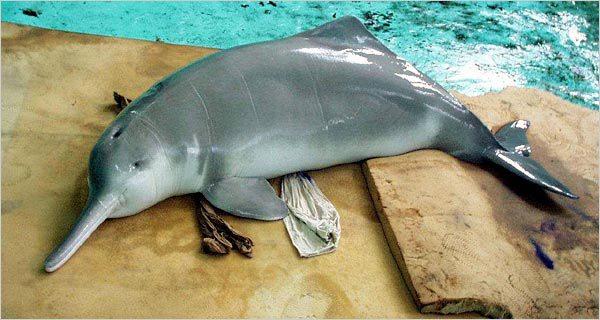
Yangtze
dolphin extinct August 8, 2007
Dolphin
brain function similar to human January 3, 2010
A
Multispecies Overkill Simulation of the End-Pleistocene Megafaunal Mass Extinction (PDF)
John Alroy, Science June 8, 2001
Why Did
Mammoths and Mastodons Become Extinct?
Two major arguments about the causes of extinctions.
Humans Might Have Wiped Out Wild Horses
Climate Change, Not Humans, Killed Large Beasts
Return to topHumans killed off Australia's giant beasts
Scientists have linked a dramatic decrease in spores found in herbivore dung to the arrival of humans in Australia 41,000 years ago. Humans hunted Australia’s giant vertebrates to extinction about 40,000 years ago, the latest research published in Science has concluded. March 24, 2012
Extinction of Australian megafauna linked to humans
From fossils of dozens of species, researchers suggest man’s use of fire is a more likely cause of death than climate change. January 27, 2007
Half-million year fossil record exonerates climate change as cause of megafauna extinction. December 22, 2006
Giant kangaroo likely killed off by humans. December 26, 2006
Researchers: Giant, prehistoric animals in Australia likely driven to extinction by humans. December 26. 2006
Ancient people sparked die-offs down under. January 9, 1999
Return to topFive extinctions with approximate dates
Major and minor extinction events, with theories for causes.
Fifth Worst Mass Extinction Linked to Asteroid Impact May 11, 2001
Marine Life Leaped From Simple to Complex After Greatest Mass Extinction November 26, 2006
Rare Soundscapes of Vanishing Habitats
Listen to sounds from rainforests.
Return to ECOLOGY