COLLAPSE
Jump to section:
Collapse of civilizations, local and global
Although our excessive population density is the cause of pending collapse, it’s often downplayed in favor of other factors: greed, capitalism, waste, and lack of development. It’s rare for solutions to include refraining from breeding. People might describe the future as a nightmare, but they still won’t conclude with, “So the last thing we want to do right now is bring another of us into the mess.”
Is Society Collapsing?
Kirkpatrick Sale writes: “American economy, like those of most of the Western world, is foundering. And no wonder: it is straining under the weight of a national debt of at least $27 trillion and national unfunded liabilities of more than $100 trillion, with a GDP of just $21 trillion to manage it with. But we have plenty of company—the world’s debt was a staggering $258 trillion at the start of the pandemic, some 320 per cent bigger than the world’s GDP, meaning we’re all living in a pipe dream unable to pay the piper.” December 25, 2020
“Collapse of civilisation is the most likely outcome”
Asher Moses writes: The world’s most eminent climate scientists and biologists believe we’re headed for the collapse of civilisation, and it may already be too late to change course.
Australia’s top climate scientist says “we are already deep into the trajectory towards collapse” of civilisation, which may now be inevitable because 9 of the 15 known global climate tipping points that regulate the state of the planet have been activated.
Steffen says it would take 30 years at best (more likely 40-60 years) to transition to net zero emissions, but when it comes to tipping points such as Arctic sea ice we could have already run out of time. June 5, 2020
High Likelihood of Human Civilization Coming to an End Starting in 2050
“On our current trajectory, planetary and human systems [are] reaching a ‘point of no return’ by mid-century, in which the prospect of a largely uninhabitable Earth leads to the breakdown of nations and the international order.” June 3, 2019.
Will humans wipe out humanity? “In Our Final Century in 2003 Martin Rees presented a range of global challenges, from bioterrorism to nuclear weapons. He put the risk of human extinction by 2100 from our technologies at around 50%.
“Our world is so interconnected it’s unlikely a catastrophe could hit any region without its consequences cascading globally. For the first time, we need to contemplate a collapse—societal or ecological—that would be a truly global setback to civilization. The setback could be temporary. On the other hand, it could be so devastating (and could have entailed so much environmental or genetic degradation) that the survivors could never regenerate a civilization at the present level.” January 4, 2019
Humanity has wiped out 60% of mammals, birds, fish and reptiles since 1970, leading the world’s foremost experts to warn that the annihilation of wildlife is now an emergency that threatens civilisation. Many scientists believe the world has begun a sixth mass extinction, the first to be caused by a species—Homo sapiens. Other recent analyses have revealed that humankind has destroyed 83% of all mammals and half of plants since the dawn of civilisation and that, even if the destruction were to end now, it would take 5-7 million years for the natural world to recover. October 30, 2018
Patrick Barkham quotes 86-year-old social scientist Mayer Hillman on the climate reality no one else will dare mention. “We’re doomed”
“I’m not going to write anymore because there’s nothing more that can be said. With doom ahead, making a case for cycling as the primary mode of transport is almost irrelevant,” he says. “We’ve got to stop burning fossil fuels.” ...the world’s population must globally move to zero emissions across agriculture, air travel, shipping, heating homes—every aspect of our economy—and reduce our human population too. Can it be done without a collapse of civilisation? “I don’t think so,” says Hillman. “Can you see everyone in a democracy volunteering to give up flying? Can you see the majority of the population becoming vegan? Can you see the majority agreeing to restrict the size of their families?
“It’s almost as if we’re deliberately attempting to defy nature. We’re doing the reverse of what we should be doing, with everybody’s silent acquiescence, and nobody’s batting an eyelid.” April 26, 2018
Experts Fear Collapse of Global Civilisation Stephen Leahy reports that, “Experts on the health of our planet are terrified of the future. They can clearly see the coming collapse of global civilisation from an array of interconnected environmental problems. ‘We’re all scared,’ said Paul Ehrlich, president of the Center for Conservation Biology at Stanford University. ‘But we must tell the truth about what’s happening and challenge people to do something to prevent it. Global collapse of human civilisation seems likely,’ write Ehrlich and his partner Anne Ehrlich in the prestigious science journal, Proceedings of the Royal Society.
This collapse will take the form of a ‘...gradual breakdown because famines, epidemics and resource shortages cause a disintegration of central control within nations, in concert with disruptions of trade and conflicts over increasingly scarce necessities,’ they write.”
PDF of Royal Society report. January 11, 2013
Apocalypse Soon: Has Civilization Passed the Environmental Point of No Return? Madhusree Mukerjee writes, “Although there is an urban legend that the world will end this year based on a misinterpretation of the Mayan calendar, some researchers think a 40-year-old computer program that predicts a collapse of socioeconomic order and massive drop in human population in this century may be on target.” May 23, 2012
John Vidal writes in the Guardian, “Abuse of the environment has created an ‘absolutely unprecedented’ emergency, according to Blue Planet prizewinners. Celebrated scientists and development thinkers today warn that civilisation is faced with a perfect storm of ecological and social problems driven by overpopulation, overconsumption and environmentally malign technologies... society has ‘no choice but to take dramatic action to avert a collapse of civilisation. Either we will change our ways and build an entirely new kind of global society, or they will be changed for us’. To transition to a more sustainable future will require simultaneously redesigning the economic system, a technological revolution, and, above all, behavioural change.” February 20, 2012
Paul B. Farrell, lists all the factors bringing on an impending collapse—including our population increase—and outlines many ways to ameliorate the situation, leaving out human breeding. A ‘no-growth’ boom will follow 2012 global crash. August 23, 2011
In The Onset of Catabolic Collapse, John Michael Greer barely refers to population density as a factor in collapse with, “As societies expand...”
“I’ve commented more than once on the gap in perception between history as it appears in textbooks and history as it’s lived by people on the spot at the time. That’s a gap worth watching, because the foreshortening of history that comes with living in the middle of it quite often gets in the way of figuring out a useful response to a time of crisis—for example, the one we’re in right now...
“Let’s start with some basics. The central idea of catabolic collapse is that human societies pretty consistently tend to produce more stuff than they can afford to maintain. What we are pleased to call ‘primitive societies’—that is, societies that are well enough adapted to their environments that they get by comfortably without huge masses of cumbersome and expensive infrastructure—usually do so in a fairly small way, and very often evolve traditional ways of getting rid of excess goods at regular intervals so that the cost of maintaining it doesn’t become a burden. As societies expand and start to depend on complex infrastructure to support the daily activities of their inhabitants, though, it becomes harder and less popular to do this, and so the maintenance needs of the infrastructure and the rest of the society’s stuff gradually build up until they reach a level that can’t be covered by the resources on hand.” January 27, 2011
Paul Ehrlich states that our “population surge means there is only a 10% chance of avoiding a collapse of world civilization.” October 23, 2011
George Mobus reviews William R. Catton’s Bottleneck: Humanity’s Impending Impasse “...it is already too late to mend our ways and somehow avoid the collapse of civilization. Indeed the main title refers to an impending collapse of the human population. An ecological bottleneck (also called a population bottleneck) is where radical changes in the environment of a species causes a die-off of all but the most hardy of the population; hardy, that is, in terms of the selection pressures arising from the change. Of course there may be no sufficiently hardy individuals left or the ones that manage to survive cannot reproduce sufficiently to produce a new population. In that case the species goes extinct.”
In Reality vs. Wishful Thinking Tim Murray writes, “When I first encountered Chris Clugston’s work some three years ago, it came as a lightning bolt. His analysis was unassailable. Finally an analytical tool—‘Societal Overextension Analysis’—that measured overshoot in a way that ecological footprint analysis did not, rendering it almost obsolete. Now Chris has fleshed SOA out. He has inventoried 89 metals and minerals that are critical to the operation of any industrial economy, and found that 69 of them are scarce and are getting scarcer. The Green Apostles of False Hope can imagine that substitutes will be found for one or two or even a dozen of them—but not most of them, and any one shortage can bring the industrial edifice down. Industrialism is unsustainable, whether it is under capitalist or socialist management.” September 5, 2011
Mike Seccombe reviews Michael Ruppert’s Confronting Collapse.
“Think of humanity as a herd of caribou living on an arctic island with no predators and abundant sustenance. We reproduce wildly until inevitably the sustenance, the energy source, is overtaxed and collapses.
“Then we begin to die. In the case of humanity, billions of us.
“The analogy and the dark prophecy are Mike Ruppert’s. And he argues it already has begun, this great dying, and there is nothing we can do to stop it.
“For the resource that has sustained human civilization for the past hundred or so years, which underpinned the quadrupling of global population and on which our whole industrial civilization is built, is in accelerating and irreversible decline. That resource is fossil fuel, and in particular, oil.” March 5, 2010
In The coming Population Wars: a 12-bomb equation, Paul B. Farrell asks, “Can Gates’ Billionaires Club stop these inevitable self-destruct triggers?” He speculates that WWIII could be caused by overpopulation. September 29, 2009
Peter Goodchild gives a step-by-step forecast of The Imminent Collapse Of Industrial Society. May 9, 2010
Richard C. Duncan describes The Peak of World Oil Production and the Road to the Olduvai Gorge. November 13, 2000

Collapse of Earth’s biosphere
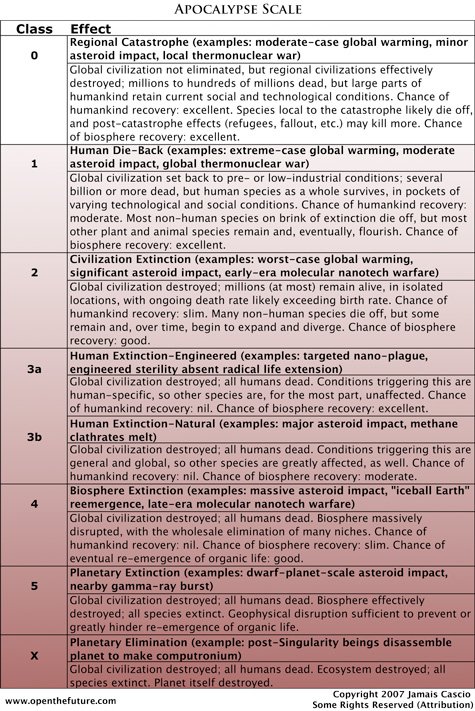
Humanity is likely to survive collapse of our global civilization: if 99.9% of us were wiped out, there would still be 8,000,000 of us. However, if Earth's biosphere collapses, lifeforms larger than mice aren't likely to make it. We are knowingly causing the Sixth Extinction, but we can't seem to stop ourselves.
Continued deforestation will doom us all, experts warn
Daniel T. Cross writes: Even as the planet’s population continues to grow apace, its forests are being cut down to make way for more grazing land, more farmland and more development. Forests are finite resources and once they are gone they are gone for good. That is why halting deforestation worldwide is a high priority.
Earth’s forest cover is at slightly over 4 billion hectares and continues to decrease, according to a new report by the Food and Agriculture Organization of the United Nations. Rampant deforestation has led to the loss of 420 million hectares in just four decades, mainly in Africa and South America.
“However, there is good news as the rate of forest loss has declined substantially over the past three decades,” the UN agency adds. “The annual rate of deforestation was estimated at 10 million hectares between 2015-2020, compared with 12 million during 2010-2015. The area of forest under protection has also reached roughly 726 million hectares: nearly 200 million more than in 1990.”
Yet unless we stop cutting down forests at anything like current rates, our entire global civilization could well be doomed within just a few decades, warn other experts.
“Based on the current resource consumption rates and best estimate of technological rate growth our study shows that we have very low probability, less than 10% in [the] most optimistic estimate, to survive without facing a catastrophic collapse,” explain the two experts, Dr. Gerardo Aquino and Prof. Mauro Bologna.
“Calculations show that, maintaining the actual rate of population growth and resource consumption, in particular forest consumption, we have a few decades left before an irreversible collapse of our civilization,” warn Aquino and Bologna.
Because forests play key roles in biodiversity, oxygen production, soil conservation, water cycle regulation and food systems, significant losses in them will trigger a cascade of environmental effects that will lead to civilizational collapse and the possible extinction of humanity, at least in its current form.
“[I]t is highly unlikely to imagine the survival of many species, including ours, on Earth without [forests],” the the physicists argue. “The progressive degradation of the environment due to deforestation would heavily affect human society and consequently the human collapse would start much earlier” than the final disappearance of forests. July 30, 2020
Plummeting insect numbers ‘threaten collapse of nature’
Insects could vanish within a century at current rate of decline, says global review
Why are insects in decline, and can we do anything about it?
Damian Carrington writes: “The rate of insect extinction is eight times faster than that of mammals, birds and reptiles. The world’s insects are hurtling down the path to extinction, threatening a ‘catastrophic collapse of nature’s ecosystems’, according to the first global scientific review.
More than 40% of insect species are declining and a third are endangered, the analysis found. The total mass of insects is falling by a precipitous 2.5% a year, according to the best data available, suggesting they could vanish within a century.” February 10, 2019
Roundup of distressing climate news Guy McPherson lists positive feedback loops which have already been triggered. January 30, 2013
We’re Scarily Close to the Permafrost Tipping Point Julia Whitty in Mother Jones reports, “Permafrost—the ground that stays frozen for two or more consecutive years—is a ticking time bomb of climate change. Some 24 percent of Northern Hemisphere land is permafrost... We really really don’t want permafrost to melt since its emissions have the potential to dwarf our own... we have the theoretical ability to control our carbon emissions but none whatsoever to stop a permafrost tipping point once it’s reached.” March 5, 2013
Another article cites a study indicating permafrost melting 40,000 years ago when temperatures were 1.5C (2.7F) higher. February 21, 2013
Earth Is Headed for Disaster, Interdisciplinary Team of Scientists Concludes. “An interdisciplinary group of 22 scientists, combining paleontological evidence with ecological modeling, has concluded that the earth appears headed toward catastrophic and irreversible environmental changes.
“Their report, in the June 7 issue of the journal Nature, describes an exponentially increasing rate of species extinctions, extreme climate fluctuations, and other threats that together risk a level of upheaval not seen since the large-scale extinctions 65 million years ago that killed off the dinosaurs.” June 6, 2012
Another article quotes from the report, “The data suggests that there will be a reduction in biodiversity and severe impacts on much of what we depend on to sustain our quality of life, including, for example, fisheries, agriculture, forest products and clean water. This could happen within just a few generations.” June 6, 2012
World’s oceans in ‘shocking’ decline. Richard Black, Environment correspondent for BBC News, notes, “The oceans are in a worse state than previously suspected, according to an expert panel of scientists.” The report (pdf). June 20, 2011
Chris Hedges writes: This Time We’re Taking The Whole Planet With Us March 7, 2011
Expert IPCC Reviewer Speaks Out.
Dr. Carter: “We are in a climate emergency, in an unprecedented Earth emergency... it’s an emergency of our climate, an emergency of our oceans... this is not one of many challenges, this is the challenge for all of humanity. A world at 1.5° C is a disastrous world, no question. 2° C is an impossible world.”
“It’s gotten so out of whack that we are now looking at survival for our children, not survival of our grandchildren.”
Roger Hallam: “We’ve established two things so far in this interview: (1) If this (abuse, overuse of the climate) carries on, they’ll be no humans left; humans are going to die and it’ll be the end of the human race. (2) There are solutions: “The most effective, definitively effective, immediately effective, readily doable action that everybody in the world can do is Go Vegan... If we do that, emissions drop immediately.”
Dr. Carter suggests a glimmer of hope, the potential for a “Golden Age.” Acknowledging humanity has accomplished a lot that is good, which we must not forget, he suggests we need to build upon it and break away from that which is destructive. November 20, 2020
“Majority of British adults convinced climate change could lead to human extinction. According to a survey conducted by ComRes, 54% of British adults believe ‘climate change threatens our extinction as a species.’ In contrast, only 25% of British adults disagreed. The survey was conducted with a sample size of 2,037 people.” May 1, 2019
“1 In 5 Millennials Think Climate Change Will Lead To Human Extinction.” April 25, 2019
“Paola Antonelli’s Milan Triennale Seeks to Restore Humanity’s Fractured Links with Nature. the Broken Nature Triennale exhibition explores humankind’s troubled relationship with the environment and suggests how we might do better.
Paola Antonelli believes in the inevitability of human extinction due to Earth’s imminent environmental collapse. But she also believes that the ever-expanding field of design, responsible in part for this disaster, has the power to soften the blow and facilitate a more harmonious end.
“On the first hand, the exhibition had to provide a sense of the long term. It’s often hard for an individual to imagine how a specific situation or innovation might impact them personally, and so it was vital to communicate that these issues and conditions would impact their children and children’s children.” April 29, 2019
Fred Guterl, Executive Editor of Scientific American, lists
8 Ways Humans Could Cause Our Own Extinction.
Cyber attacks
Bioweapons
Viruses
Species extinction
Disruption of weather patterns
Venus Syndrome
Nuclear War
Meteorite impact
“No single one of these issues is necessarily a world ender. It’s not like we’re going to catch a bad flu and go extinct as a species, or that the stock market will crash and the world will be plunged into a thousand years of darkness, or that the seas will rise and engulf us. But taken together, it seems as though the world is headed into a period of great vulnerability. Climate and disease and food and economics are not wholly separate things—they are intertwined. If we are pushing everything closer and closer to some tipping point, it stands to reason that we are taking a risk.” May 22, 2012
Guy McPherson describes Three paths to near-term human extinction. “About a decade ago I realized we were putting the finishing touches on our own extinction party, with the shindig probably over by mid-century. During the intervening period I’ve seen nothing to sway this belief, and much evidence to reinforce it.” November 9, 2011
A slide show of 10 roads to human extinction
A large number of links about The Apocalypse.
“[Humans] will become extinct. We need to design an elegant ending. Paola Antonelli discusses the end of humanity, the idea of design reparations, and her forthcoming exhibit ‘Broken Nature.’ It is frankly a fact of nature. Everything extinguishes itself sooner or later. Usually, it happens over thousands of years. We’re proceeding faster than many other species that have become extinct. I don’t see any other possibility. Our sense of omnipotence and our sense that the universe revolves around us and we will last forever is very misguided.
The other idea is the concept of reparations by design. It’s the Anthropocene. We have truly acted with arrogance as colonizers. We have enslaved nature, other humans, and animals. We have behaved with irresponsible narcissism. So we should pay reparations. We should try to restore and give back, and reposition ourselves in the universe. When we damage nature, we damage ourselves.
Efforts to prevent collapse of civilization and involuntary human extinction
Preventing involuntary extinction of ourselves, and tens of millions of other species, is a primary goal of the Voluntary Human Extinction Movement. The following efforts reveal the depth of human superiority and a belief that our existence must be preserved at all costs.
The Commission for the Human Future
Canberra, March 2020: A group of Australian scientists, business leaders, public servants, and academics calls for the world’s nations to come together to develop a strategy for human survival.
They identify risks:
Decline of key natural resources and an emerging global resource crisis, especially in water
Collapse of ecosystems that support life, and the mass extinction of species
Human population growth and demand, beyond the Earth’s carrying capacity
Global warming, sea level rise and changes in the Earth’s climate affecting all human activity
Universal pollution of the Earth system and all life by chemicals
Rising food insecurity and failing nutritional quality
Nuclear arms and other weapons of mass destruction
The Earth Is Telling Us We Must Rethink Our Growth Society
“In two centuries, human population has spiked seven-fold and consumption by 100 times. ‘The Earth will have its revenge,’ warns systems ecologist William Rees, co-inventor of the ecological footprint concept.
There are no exceptions to the first law of plague dynamics: the unconstrained expansion of any species’ population invariably destroys the conditions that enabled the expansion, thus triggering collapse.
The challenge is to engineer a safe, smooth, controlled contraction of the human enterprise. Surely it is within our collective imagination to socially construct a system of globally networked but self-reliant national economies that better serve the needs of a smaller human family.
The ultimate goal of economic planning everywhere must now turn to ensuring that humanity can thrive indefinitely and more equitably within the biophysical means of nature.” April 6, 2020
How Tragic Would Human Extinction Be? “Convergent Arguments for Making the Survival of Our Lineage a Global Priority. This paper synthesizes a wide range of distinct moral and axiological arguments that all converge upon the evaluative conclusion that human extinction, if it were to occur, would constitute an immense tragedy.
... humanity does not yet know what the correct conception of morality is, and thus does not currently understand how tragic our extinction might be. This makes the prospect of our imminent disappearance even worse, because it suggests that we might never know just how valuable we were or how important our survival is.”
Likewise, humanity does not currently understand how wonderful our extinction might be. Maybe we haven’t figured out what the “correct conception of morality” is, or maybe we know but can’t admit how much of our behavior toward human and non-human animals is immoral, if not evil.
Centre for the study of existential risk University of Cambridge. “We are dedicated to the study and mitigation of risks that could lead to human extinction or civilisational collapse. Working together to safeguard humanity. We are an interdisciplinary research centre within the University of Cambridge who study existential risks, develop collaborative strategies to reduce them, and foster a global community of academics, technologists and policy-makers working to safeguard humanity. Our research focuses on biological risks, environmental risks, risks from artificial intelligence, and how to manage extreme technological risk in general.”
Future of life Institute “Technology is giving [human] life the potential to flourish like never before, or to self-destruct. Let’s make a difference!
“An existential risk is any risk that has the potential to eliminate all of humanity or, at the very least, kill large swaths of the global population, leaving the survivors without sufficient means to rebuild society to current standards of living.”
“Grand Thermal Challenges to save humanity from extinction due to climate change.” August 16, 2020
Sandra Feder writes of a Stanford course on human extinction and cognitive biases. “The course covers four threats to the existence of humanity: nuclear war, infectious disease, climate change and malevolent uses of artificial intelligence.” And “...cognitive biases that impede our ability to think about extinction, including being hard-wired to focus on the short term and the tendency toward optimism.” June 2, 2020
Cooper Veit writes that Stanford launched the official “Stanford Existential Risk Initiative, which aims to ‘foster engagement from students and professors to produce meaningful work aiming to preserve the future of humanity.’
“Specifically, its goal is to prevent global catastrophic risks that threaten to destroy human civilization or drive the entire species extinct. THINK 65: ‘Preventing Human Extinction,’ is now in its second year and has about 100 students.” May 20, 2020
The human race is not special. Geoff Dawson asks, “So why do we think we're immune to mass extinction? ...it’s a worst-case scenario that is beginning to be seriously discussed.
Psychoanalysts use the term ‘manic defence’ to describe how human beings can pathologically cling to optimism and hope as a way of denying their depression and anxiety.
To contemplate mass extinction is indeed a dark place to go to and a difficult conversation to have... because it is to think the unthinkable.
But spiritual traditions across the world believe it brings depth and richness to our lives to contemplate our own death. It does not necessarily have to be a morbid preoccupation.” 2 March 2020
How to Survive the 21st Century
Speakers: Yuval Noah Harari, Mark Rutte, Orit Gadiesh
Nuclear war, ecological collapse and technological disruption pose an existential threat to human civilization. Join a conversation that explores the challenges of the 21st century and how to address them before it is too late. January 23, 2020
The Psychology of Existential Risk: Moral Judgments about Human Extinction Stefan Schubert notes, “Humanity’s ever-increasing technological powers can, if handled well, greatly improve [human] life on Earth. But if they’re not handled well, they may instead cause our ultimate demise: human extinction. Recent years have seen an increased focus on the threat that emerging technologies such as advanced artificial intelligence could pose to humanity’s continued survival. A common view among these researchers is that human extinction would be much worse, morally speaking, than almost-as-severe catastrophes from which we could recover. Since humanity’s future could be very long and very good, it’s an imperative that we survive, on this view.
“A conclusion from our studies is thus that laypeople’s views on the badness of extinction may be relatively unstable.” October 21, 2019
Escaping extinction through paradigm shift.
Nafeez Ahmed writes: “‘Rebellion’ is not enough. We need to build new systems from the ground up, right now. Let us build our own capacity as individuals and members of various institutions to think and do differently within our own consciousness and behaviour, as well as across energy, food, water, culture, economics, business, finance. By doing so, we plant the seeds of an emerging paradigm of life and reality that redefines the very essence of what it means to be alive.
This is the conversation we need to begin having, from our boardrooms, to our governing councils—for those of us who have woken up to what is at stake, the real question is, how can I actually mobilise to build the new paradigm?” May 10, 2019
A small group of researchers is studying how science could destroy the world—and how to stop that from happening. Philosopher Nick Bostrom believes it's entirely possible that artificial intelligence could lead to the extinction of Homo sapiens. Scientists have an obligation to be involved, says Tegmark, because the risks are unlike any the world has faced before. Every time new technologies emerged in the past, he points out, humanity waited until their risks were apparent before learning to curtail them. “Humanity's strategy is to learn from mistakes,” Tegmark says. “When the end of the world is at stake, that is a terrible strategy.” Jan. 11, 2018
“The circumstances don’t matter. The very loss of the continuation of our species would be a tragedy.
The only marker that we were ever here is the continued existence of our species. It is the only imprint left on the earth from our evolutionary forefathers. If humans became extinct, it would be a tragedy for everyone that ever came before us. It would erase their legacy.
In as much as we have an obligation to protect the interests of the future generations, we also have an obligation to protect the legacy of those who went previously. September 2014
Books about collapse of civilizations
The Collapse of Complex Societies (1988) Joseph Tainter, archaeologist at the University of Utah
Collapse: How Societies Choose to Fail or Survive (2005) Jared Diamond
The Upside and Down: Catastrophe, Creativity, and the Renewal of Civilisation (2006) Thomas Homer-Dixon
Evolution’s Edge: The Coming Collapse and Transformation of Our World (2008) Graeme Taylor
End Times: A Brief Guide to the End of the World (2019) by Bryan Walsh
“End Times... peels back the layers of complexity around the unthinkable—and inevitable—end of humankind. From asteroids and artificial intelligence to volcanic supereruption to nuclear war... Bryan Walsh provides a stunning panoramic view of the most catastrophic threats to the human race.”
Human survival after collapse of civilization
To be arranged. Humans surviving a dieoff could learn hunter-gatherer skills, if they haven’t already, and small populations could sustain themselves on what’s left of the natural world. We’re so fecund and clever that a new voluntary human extinction movement could emerge in 10 or 20 thousand years
